 |
|||||
|
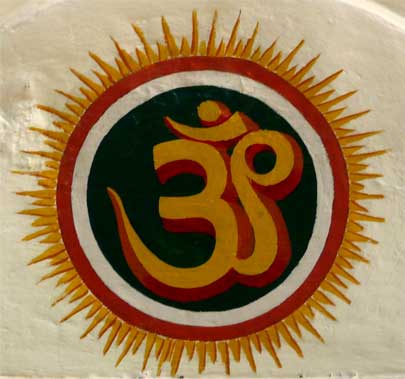
THE SCIENCE CALLED HINDUISM Most people including Indians have an idea that all religions especially Hinduism are filled with superstition and are most unscientific. Today I would like to prove to you that this is far from being the case. In fact, Hinduism is a science, which is also a religion. Scientific facts are so interwoven with our religious habits and symbols that people have forgotten that their basis is scientific. India has maintained the longest unbroken, continuity of civilization in the whole world. It is a living relic of the ancient past of not just India but the past of the whole history of humanity and thus it follows that Hinduism is the oldest religion. The Upanishad says , “Satyam eva jayati naanrutam,” “Truth alone shall prevail, not falsehood.” What is Truth and how is it to be known? Time alone is the touchstone of truth. However much one tries to stamp out Truth it shall not be overcome. Hence, Hinduism, which is based on Truth, can never be stamped out and has existed from the dawn of time. The universe exists on Truth and anything that is not founded on Truth is automatically deleted by Time. Many religions and many cultures have come and gone. One by one, they have been mown down by the relentless scythe of Time. Hinduism alone has remained. This is because it is based on the eternal verities – satyam, ahimsa and dharma, truth, non-violence and righteousness. This is the cosmic dharma – the law of eternal justice by which this cosmos has been created, sustained and destroyed. That is why Hinduism is known as “sanatana dharma”, the ancient law of righteousness. The sages desired that that our country should progress not just materially but through a constant inner renewal of the cosmic law of righteousness, guided by the wisdom embedded in our scriptures. For this, they gave many paths called yoga, which are all scientifically based which would lead the human being to discover his blissful inner self. Moreover we find that every time this dharma showed signs of declining, God Himself took an incarnation to revive it. As Krishna told Arjuna in the Bhagavad Gita “Yada yada hi dharmasya glanirbhavati, “Whenever this dharma declines O Arjuna, I incarnate myself “dharma samsthapanarthhaya sambhavami yuge yuge.” I incarnate myself age after age in order to re-establish this ancient dharma. Thus our country has had many avataras as well as great sages who have incarnated themselves in every age in order to uplift this dharma and hence it has remained in its pristine glory for countless years. 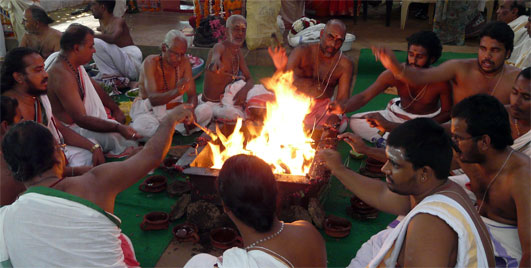 Maha Rudra Yagya What exactly is science? Science is something, which tries to discover the different laws of nature. Our ancient rishis who were the custodians of our culture were the greatest scientists ever known to man. They were a special type of scientists. They can be called spiritual scientists. They realised that the foundation of the universe as well as of the human being is spiritual not material. All the gross objects, which we see in the world actually have their source in the subtle and not vice versa as science will have us believe. The rishis also looked at the world and like every scientist wanted to find out the basic constituent of everything but unlike the western scientist they realised that they would never find the meaning of anything in the world if they did not know the laws governing the functioning of their minds. So, psychology which is such a baby science in the west was the first one that the rishis explored. They realised that the world existed because of the human mind and unless they learnt to control the mind, they would never be able to find the meaning of anything in the universe, far less control it. Their investigations into this made them discover that the foundation of everything was spiritual and not material. In fact long, long before the western science discovered it they said that the world of matter, which the senses show us is actually an illusion. The word they used to explain this was “maya’. What the rishis meant by maya is something that does not exist in the form that we perceive it. They never said that the world was an illusion; they only said that our perception of it is an illusion. It is only with the dawn of the 20th century that the west has come up with this idea that matter is only energy in motion. The quantum physicist says that we see the world of matter as if it is solid but it is far from being solid. It is only a dance of protons and electrons. The dance of Shiva Nataraja actually portrays this dance of the elementary particles. Instead of putting these truths in a dry way as a mathematical equation the rishis used the language of poetry and painting in order to bring these inexpressible ideas into the minds of ordinary folk. Even today very few people are able to grasp the quantum theory but everyone is capable of admiring the graceful lines of Shiva Nataraja. Einstein also showed us that Time and space are not eternal verities but convenient suppositions of our mind. This again was known to the rishis. In fact they said that human life is completely conditioned by the three upadhis (conditionings) known as desa, kaala and nimitta- space, time and causation. Everything we see in the world, exists in space for a certain period of time and has a cause. This is how the mind works. Without these three upadhis the mind cannot function. The rishis had their own method of calculating time. They knew of light years. The life span of Brahma the creator is known as a kalpa, which is the longest period of time which we can think of -millions of light years. They also had words to describe the minutest period of time, less than the blink of an eyelid. They knew about atoms which were called anus and even particles which were called parmanus. As for space they knew that our galaxy was only one in infinite space in which many such galaxies like ours exist. Please understand that these discoveries were very recent in western science. In the Devi Purana, the Maha Devi takes Brahma, Vishnu and Shiva for a joy ride in her chariot and they pass many such galaxies and she points out to them that each one has its own Brahma, Indra and set of gods each busy with his own function. She explains to them that this galaxy is not the only one and that many such galaxies exist in her control! 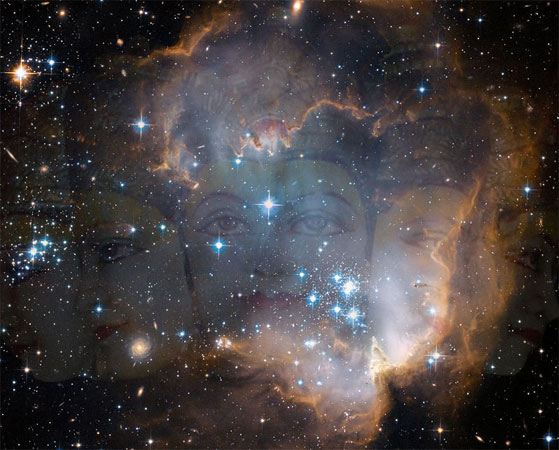 NASA
Now let us have a look at our ancient method of reckoning time. One Vedic calendar goes back to 3000 years and another goes back to 6000 years. The western world could not believe or did not want to believe that the ancient rishis were such experts in Astronomy that they could actually make such accurate calendars. They insisted that the Hindus must have stolen it from the Greeks. Actually, the opposite is true and the Greek calendar uses many of the words of the ancient Vedic calendar. The western world had always taken Greece to be the source of all modern culture and western scholars do not want to believe that Vedic culture existed much earlier than the Greek. Some scholars have claimed that the Babylonians invented the zodiac of 360 degrees around 700 BCE, perhaps even earlier. Many claim that India received the knowledge of the zodiac from Babylonia or even later from Greece. However,in the Rig Veda, the oldest Vedic text, there are clear references to a chakra or wheel of 360 spokes placed in the sky. The number 360 and its related numbers like 12, 24, 36, 48, 60, 72, 108, 432 and 720 occur commonly in Vedic symbolism. Why does our new year start on April 14th? As you know the earth revolves around the its axis and around the sun. Our Vedic astronomers said that the earth’s revolution round the sun starts from the fixed point known as Mesha sankranthi rekha, which is the Alpha Aries point. This is why our astronomical new year’s day starts on Mesha sankranti, which normally falls on April 14th. In Sanskrit it is known as mesha vishuvath . The Kerala New Year is called Vishu from the word vishuvath. As usual, Hinduism conntects science with spirituality. The time of the change of the sign from meena to mesha (mesha sankranthi) is known as punya kaalam , or an auspicious time and hence many spiritual practices are done on this day. All the laws of nature have their corresponding components in the life of the human being. Hence you find that our law of karma is actually only a spiritual interpretation of Newton’s 3rd law of Thermodynamics which says that every action has its equal and opposite reaction. So also every mental action which actually means our motivation has its own equal and opposite reaction. Any action which is done with a certain desire or motive has to be fulfilled. The fruit of that desire will come bouncing back to us one day or other. If some actions do not get their results in this life then one has to take another life in order to enjoy the benefits or the punishment for our good and bad actions. Like all laws of nature, this law of karma cannot be diverted or by-passed. This is why the Hindus believe in reincarnation ,which is actually based on this scientific law of nature. Vedic astronomers were also able to describe the different planets and had names even for Uranus, which is only a recent discovery. They even predicted the length of time for Hailey’s comet to reappear. Since they were so good in astronomy, it followed that they were also very good in astrology. There is a form of Indian astrology called the Nadi Shastra which keeps track of every person’s past, present and future life. These were written on palm leaves by great saints or siddhas – Agastya in the south and Brighu in the North and are preserved by certain families up to the present day so that anyone who goes to these people will find a leaf, which describes their whole life! These leaves are found not only for Indians but also for foreigners and people belonging to other religions. 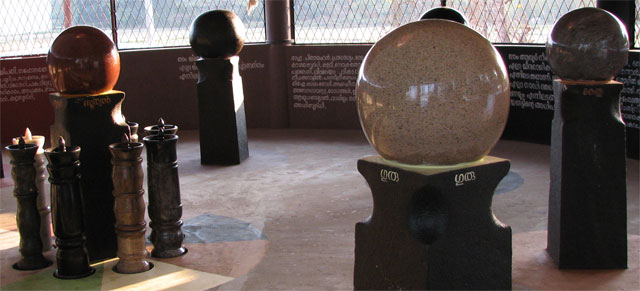 Vedic Temple of the Cosmos Now the question arises how these people found out so much about the planets without any instruments. The reason is simple. "Instruments are only the extensions of a human being’s inherent powers," - the power to see, to hear, or to accomplish things he wants done. For example, a telescope allows us to see distant objects like the planets, a microscope allows us to see tiny objects. Unless we have eyesight neither of these instruments will work. However when these powers are developed in oneself, then one has them at his or her command by the mere power of thought without the need for instruments. You must remember that the rishis were in perfect control of their minds. "So if the rishis wanted to find out about the planets or about anything else, all they had to do was to concentrate on that object and they were able to find out everything they wanted about it. This of course is an infallible method and that is why their findings have never been refuted up to the present day whereas in the west one person would discover something and another person would come and refute it and such things are going on even now. The rishis were also able to intercept the electro magnetic waves and tune in to things which were happening in other places without the using a radio or TV. They could also visit other planets in their astral bodies. It is only if we want to transport our physical bodies that we need rockets and space ships but the rishis could travel in their astral bodies and thus they were able to find out many things about other planets. The microcosm is only a reflection of the macrocosm and thus everything that takes place anywhere in the cosmos can be known by the human being. The sciences of parapsychology and telepathy are all very new to the modern mind but these phenomena were well known to the rishis. The Western mind considered Nature, God and man to be totally unconnected. The rishis on the other hand realised that all these are actually inter-connected and what affects one part will affect every other part. If Nature is defiled, man will have to suffer which is what is happening to us now. Western science even now cuts up Nature into different parts and probes into these various aspects as if they were totally unconnected. Western doctors also cut up the human being into parts and have specialists for different parts – for the nose, for the eyes, for the toes and so on. They like to believe that both the human being and Nature are a conglomerate of different parts and have shut their eyes to the fact that both these are actually wholes. It is better to treat the human being as an organic whole than as a collection of parts and the same applies to nature. Let us look at their knowledge of medicine. Ayurveda is the science of life and health not of disease and death. It tells us how to remain healthy rather than telling us how to treat ourselves after we contact a disease. It makes use of nature and natural substances to create health. The sun, air, water, earth are all used as well as a large amount of herbs which nature has provided us with. They were great botanists. Their knowledge of plants and herbs was amazing. The names of all these life- giving herbs have been detailed in the great books on Ayurveda. Dietetics is a very new idea in the west but from ancient times Ayurvda said “Let food be your medicine and medicine your food.” So they were well aware of the importance of a good healthy diet in order to upkeep one’s health. They knew that prana or the vital breath of the universe was what kept the body in health and not the use of externally injected medicines. Prana has to be revitalised by eating life-giving foods. They also knew many esoteric truths which are only now being discovered by scientists but again since these scientific facts are interwoven into the daily life of the Hindu, we fail to realise that they are indeed most scientific. Let us take us take the example of the theertham or charanamrit which we get from the temple. This is consecrated water that has been poured over the deity to the chanting of mantras. A Japanese scientist has recently proved that the molecules of water undergo a drastic difference and coherence when positive vibrations are passed through it. Our ancient scientists, the rishis were well aware of this fact. 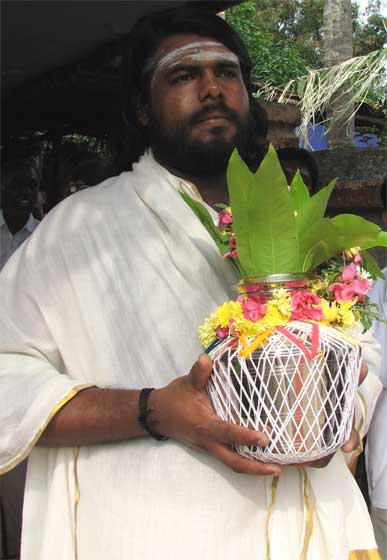 An offering of water is the highest token of respect. This is why the theertham or charanamritam which is poured over the deity after the chanting of mantras have such a strong effect on the person who drinks it. Even the Hindus themselves do not realise that this is not just any water but water that has been potentised with mantras. The molecular structure of this water is totally different from ordinary water which has not been treated. When we take our bath, we are asked to chant a certain mantra. By repeating this mantra which has positive vibrations the negative qualities of the water would be made positive. The same case applies with the food we eat. We are told to chant certain mantras and circle the food with water held in our palms and then sprinkle some of that water on the food and drink the rest. It is only now that modern scientists have come to realise that this chanting and sprinkling of the water produces untold benefits. Now let us look at their knowledge of cosmology. You know how much sound is produced by our fans or our air cons or anything which goes whirling around. We know that the earth is whirling on its own axis with the moon round it and it is hurtling round the sun at a great speed. We also know that every star in our milky way is actually a sun with its own planets gyrating round it. In fact these galaxies are moving at 20,000 miles per sec and they create an amazing sound. 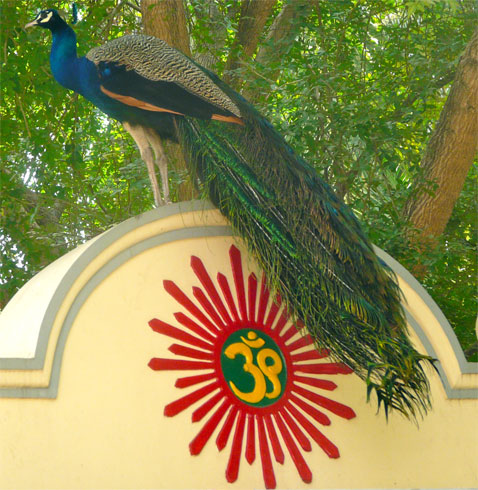 The sound thus generated cannot be heard by the normal human ear but it was heard by the rishis and they said that this was the sound of aum, the cosmic hum of the creator. This discovery is attributed to the great sage Vishwamitra and he is also the seer of the great mantra known as the gayatri . This mantra has amazing propensities for taking us to higher levels of consciousness. Its greatness is only just being recognised by the western world. Later on other religions realised the importance of aum and called it as amen and ameen. The three words of the gayatri, bhur, bhuva and swar stand for the three spheres. Bhur stands for the earth sphere, bhuva points to our immediate galaxy with the sun at the centre and swar for the galaxies which exist beyond ours. All these create sounds and the Gayatri mantra includes all this in its sphere of influence and hence it includes the totality of the energy generated in the universe and beyond it and thus it has great force if used properly. The total kinetic energy generated by the galaxies moving at 20,000 miles per sec creates an amazing sound and this acts as an umbrella and balances the total energy consumption of the cosmos. The rishis were experts in the science of sounds known as phonetics. All the mantras denoting the various gods have a great scientific basis. The letters of the mantras constitute an alphabet of forms in a capsule of form, sound and power. They denote that formless Absolute which is beyond all forms yet is the cause of all forms. Hence our gods are the outcome of this great science - the science of sound giving rise to forms. The rishis implanted a spiritual seed in every action of the human being and thus Hindusim is more a way of life more than a religion. If we follow the rules set forth by the rishis for a good life we will find that every one of them had a scientific basis. Unfortunately, our youth who have such faith in science do not realise that the basis of Hinduism is science. Let us look at the way Hindus greet each other. We hold our palms together with the tips of the fingers touching each other. This stimulates the nerve endings, which are connected to various parts of the body. Scientific studies have shown that the pressure points on our palms are connected to every organ in the body and if massaged regularly, we can keep up our health very easily. The mudras which are used like joining the forefinger with the tip of our thumb and sometimes with the middle fingers are all capable of activating certain points and chakras in the body, thus making us more alert and alive. In olden times every Hindu used to use a dot or mark in the centre of his or her forehead. This point is actually the ajna chakra which is the seat of intelligence. When we meet a person, our eyes are immediately drawn to the dot in the middle of the other person’s forehead. The other person will have a similar experience and thus each will be able to draw the best from the other since they are both concentrating on the third eye. What about the strange way we catch our ears with opposite hands and bob up and down in front of Ganesha. This exercise has recently been discovered to have amazing health benefits since the lobes of the ears contain a number of nerves, which stimulate the brain centres. The act of going up and down also greases the knees and elbows and keeps them supple. Every action which the Hindu is supposed to do from the time he gets up to the time he goes to bed has some scientific basis. Every thought and action of the human being has a deep impact on the universe as a whole. Thus they insisted on the deep consideration which had to be shown to nature. Nature or Prakriti was not inert matter to be used and misused according to our pleasure but she is a pulsating, living being and has to be treated with all consideration and love. Only then will she yield her resources to the human being. But western science taught us to despise and degrade nature and now we are reaping the consequences of these views. She is a strict taskmistress and her fury when aroused can wipe us all from the face of this earth. It is only now that western science is recognising this. The first thing that we are supposed to do when they get up is to touch the earth with our palms and repeat a certain mantra to the earth goddess. There are two important reasons for this. One is to remind us of the great duty we owe to the earth -our very first mother. We ask her forgiveness for stamping on her, digging her and all the hundreds of dreadful things we are doing to her now. “Vishnu patnir namasthubhyam, padasparsham kshamaswame. Another reason is that this small insignificant act actually gives our body the earthing it needs. The poles within our body needs to be earthed and this act does that. Every aspect of the pujas which are conducted in temples again have very great scientific meanings behind them and give great benefits to those who participate in the pujas and especially take the prasad which is distributed. This prasad is filled with positive vibrations and if you notice at the end of the puja the consecrated water is sprinkled on the heads of the people who are gathered there. Needless to say this water has positive vibrations. 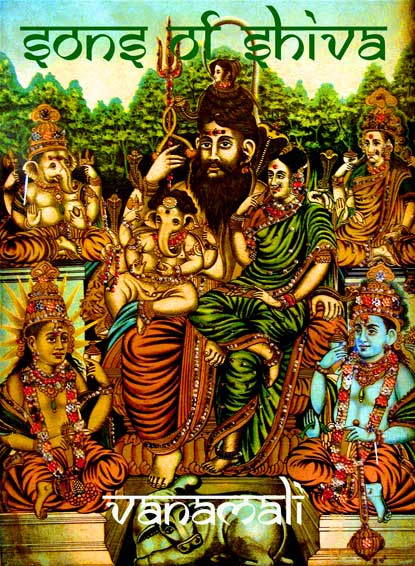 Now let us come to the meaning of the different gods especially the sons of Shiva. Shiva stands for the supreme Brahman and Parvati for Shakti or the creative force of Brahman. The sound of Aum is said to be the initiating cause for the universe of forms. The Sanskrit letter aum resembles the head of an elephant with an upraised trunk. Thus Ganesha is pranava swaroopa In the alphabet of forms devised by the rishis, Ganesha comes first. He represents the foremost initiating power of the Supreme at every stage of evolution. He is kept at the Muladhara chakra and personifies the force of gravity. The story of Kartikeya is again the story of creation. He was born from the seed of Shiva which was ejected into the etheric sphere and carried by Vayu or the wind to Agni or fire who dropped it into the water who took it and deposited it into the earth. Thus the five elements of ether, air , fire, water and earth combines to nurture this child of Shiva- the supreme Brahman. The two great forces in nature are gravity and electromagnetism . If Ganesha represents the force of gravity, Kartikeya represents electromagnetism. His vel or spear works deeply within us like the powerful force that binds electrons and neutrons together. This power emanates from his spear like energy expanding through the universe in the form of radio and light waves. We experience the dualities of light and dark, positive and negative which are the electromagnetic forces that issue from Karitkeya’s vel. Shiva and Parvati themselves signify the opposite poles of creation which are absolutely necessary for all creation. Similarly everyone of our gods hide great scientific truths behind their extraordinary appearances. Ganesha with his elephant head exemplifies the enlightened person who can discriminate truth from falsehood, ultimate truth from unreality. His big head is only a pictorial representation of this. His trunk is capable of lifting up big logs but it can also pick up a small pin from the ground and he represents the force of gravity as has been said. That is why his position is at the Muladhara chakra or base of our spine, which holds us down to the earth. Kartikeya on the other hand represents the force of electromagnetism. His spear or vel which is his most powerful weapon glints when turned here and there and sends out these currents and magnetic waves. The worshipper of Kartikeya could control these waves and these masters could actually decode these waves and see the pictures or hear the sounds without the necessity of using a TV screen or recorder. Today we are releasing another of these great forms – the form of the wind god Hanuman. Vayu or air or prana is the life giving force in the universe. We might be able to live without food for quite a while and without water for a short while but we cannot live without air even for a few minutes. So Hanuman is known as Prana deva or the god of the life force and thus he can inspire us in every single one of our actions. Let us thus pray to this god and invoke him to bless all of us with the energy needed to push forward towards an enlightened life. 2012 is supposed to bring about a face change in the world and Hanuman can certainly help us to bring about this change. Hence the devotees of Hanuman seem to be increasing the world over. May he bless and guide us. Jai Hanuman. 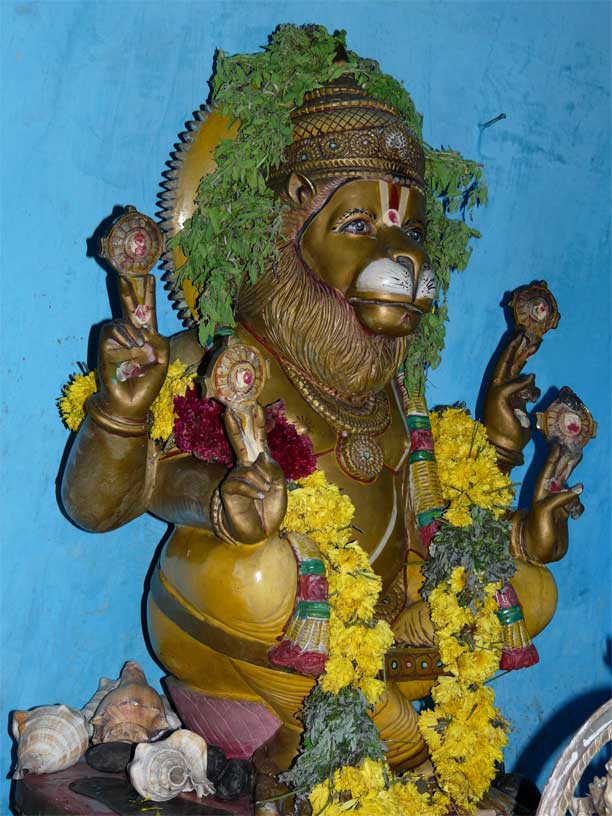 Hinduism Hinduism is a name given by the westerners to the oldest religion in the world. It was originally known as Sanatana Dharma or Eternal Righteousness. Dharma is the cosmic law of righteousness by which the whole universe revolves and evolves and this is why the ideas and beliefs of Hinduism have existed from time immemorial. It has an ability to evolve with the changing times and this is the reason for its continued existence. Anything which is static and stagnant will eventually decay and die. Just as water has to flow in order to keep itself free of impurities so also every religion must have the ability to grow. Many of the ancient religions of countries like Egypt and Mesapotamia which were really highly evolved, have been wiped off the face of he earth with the passage of time,whereas Hinduism has continued to exist. To understand this better I will give you an illustration. Western religions can be compared to a monolithic iron pillar which is incapable of bending or giving way or changing, Hinduism can be compared to a banyan tree which has spreading branches which reach out with ever more new shoots and more ideas. That is why we find more religions within the Hindu faith than there are in the rest of the world put together. All new ideas are always welcomed into the Hindu fold. Because of this there was no antagonism between science and religion in India as there was in the west. Some of the western scientists like Copernicus were executed for having dared to say something which went against the teachings of the bible. In India however our rishis themselves were the greatest scientists. When we look into the Vedas we will be astonished to find how much they knew about astronomy, astrology, economics, mathematics, botany. It has taken the west many centuries to catch up with the discoveries found in the Vedas. In fact it is only in the 20th century that the west has found out that many of the facts of this material world which has been claimed in our Vedas are actually the truth.
Let us take the word Maya for instance which is the word which Vedanta uses to describe this world. What exactly did they mean? Maya means illusion - something which gives the appearance of reality but is actually unreal - an illusion. Till the beginning of the 20th century everyone scoffed at this idea as some strange notion of those bearded, stupid rishis of ancient times. But with the advent of quantum physics we realize that what the rishis said is actually the truth. First of all Einstein proved that matter is nothing but energy in motion and the quantum physicist proved that in the quantum field, which is the ultimate state of matter, the physical world as we know it through the five senses does not exist. Matter is composed of energy particles which act in a random manner. Sometimes they act like particles and sometimes like waves and they do not follow any of the fixed rules of physical matter. They themselves used the Sanskrit word and called this the maya world of physics. Just imagine how long the western scientist took to discover something which the ancient rishis had declared thousands of years ago. Now let us take the idea of time and space. These had been declared by the western physicists as eternal verities. But Einstein's theory of relativity showed that time and space are mental creations and have no actual reality in themselves. Einstein said, “Everything is relative. There is nothing called the Absolute.” Our rishis declared, “Only the Absolute is real. Everything else is relative.” So actually the rishis have gone one step further than the physicist. They have still to realize that there is something called the Absolute . Many Puranic stories show that the rishis were well aware of the unreality of time. They knew that time in other planets is quite different from time in this planet. King Revathan, the father of Revathi who married Krishna's brother, Balarama, took his daughter and went to Brahma's world and stayed only for the duration of a dance but when he returned to this world he found that one eon of time had passed and though he had gone in Treta Yuga, he returned only in Dwapara Yuga! So they were well aware of the relativity of Time. As I said these rishis were great scientists and it has taken the west many centuries to catch up with them. All our scriptures say that “desha, kaala and nimitta” or Space Time and Causation are the three upadhis or bonds which prevent our minds from seeing the truth.
Now let us take up some practical points about Hinduism. Children living abroad are usually battered by questions about their religion by other children and parents should have certain points clear in their minds so that they can answer their questions. One of the common accusations is that we have so many gods when they have only one. How do we explain that. The fact is that actually we also have only one god but it is an impersonal, all-inclusive god which is available to all creatures and people at all times and in all places that is to say- our god is beyond space and time. However the one god of the Semitic religions is an absolutely personal and exclusive god available only to the followers of that particular religion or creed. Anyone who does not believe in him is condemned to eternal hell. Our one God is a formless, universal principle available to all people whether they believe in Him or not. This formless, eternal, unlimited Being is known as Brahman. HE has ever existed and will continue to exist whether people believe in Him or not. Nothing else can exist if He were not to exist. He will not condemn anyone to eternal hell just because they do not believe in Him. How is it possible to believe in a compassionate god who will condemn his own children to eternal damnation? Even a human father will not do this.
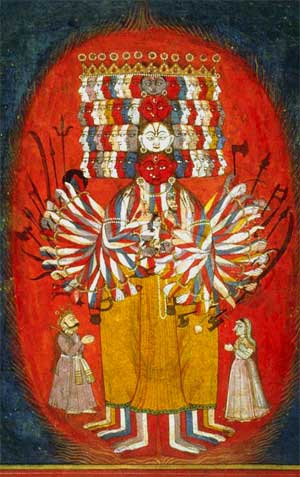
Now to revert to this question of the many gods of the Hindu pantheon. God has created each one of us in a different fashion both physically and mentally. We like to dress differently, choose different partners and eat different types of food. How is it possible that god has restricted us so cruelly in this important choice of what to worship. How can He demand that we can worship Him only in one form? It is the human being who has limited this unlimited being to one form and one way. There are as many ways to approach him as there are human beings and as for forms countless are his forms. That which is formless can take on any form. To limit the limitless is real blasphemy. Each one of the five children of a human father may have different dispositions. Can he insist that they should all become doctors just because he is a doctor? God allows us to worship him according to the form of our choice. This is what Hinduism declares. Hence the great tolerance you see in Hinduism. Whereas the Semitic religions insist that you have to worship him as Allah or Christ or Jehovah, Hinduism says you can worship him as Krishna or Christ or Rama or Allah. The name means nothing if you have the understanding that every form is His form, every name is His name. He is ananta nama and ananta rupa -with thousands of names and forms. This is the esoteric principle underlying idol worship. The great hymn of the Vedas known as the Purusha sukta says, “sahasra sheersha Purusha sahasraksha sahasrapath etc”.The supreme Person has many heads, many arms, many eyes, he exists everywhere at all times and all places. This fact must be made clear to our children so that they can give proper replies to the children of other faiths. The Gita says, “Ye yada mam prapadyante, tam stataiva bhajamyaham” “In whatsoever a way a person approaches me, I will go to him in that very form and strengthen his faith in that form.” What could be more tolerant than this? This is the reason that India gave asylum to many people of different faiths who were being persecuted for their beliefs. There used to be a full fledged Jewish community in Kerala. The king gave them land just next to his own palace and there is a history of peaceful co-existence between them. When St.Thomas arrived, he was given a warm welcome by he king but unfortunately the 'xtians fully believe that it is only their religion which can save people and thus he betrayed the king's trust ad started converting people to 'Xtianity. Conversion is a very strange idea to the Hindu. We believe in one Supreme power which can be worshipped according to our own bent of mind and according to us conversion is an insult to god's justice since it concludes that He does not know how to rule his own subjects. Thus you find that there is no such thing as conversion in Hinduism. If you follow and believe in the tenets of Hinduism, you are a Hindu, whatever you may call yourself. Thus Hinduism is built on jnana -knowledge - knowledge of the true nature of the Supreme Person. If you worship any form without this knowledge it will lead you to trouble. That is what we are finding in the world today. All Semitic religions are religions filled with bhakti or devotion. However they have no true knowledge. They have only a limited view of that Supreme Being and so they have confined him to one form. Thus bhakti without jnana leads to fundamentalism. This is the basic problem with the world today.
Another of the great pillar stones of the Hindu faith are the theory of Karma and reincarnation. When we look at the world around us we see many discrepancies. There are many people around us who are lame and blind and dumb - there are lepers and aids patients and so on. How can an all compassionate God have condemned his children to such a fate? It is only Hinduism that can give a proper scientific answer to this most important question. The theory of Karma is an impersonal and scientific theory which corresponds to the 3rd law of thermodynamics which says that every action has its equal and opposite reaction. Hinduism says that every time we do an act we expect certain results from this act and those results have to come back to us in some form or other. If I steal something, or kill someone, I might manage to escape human laws but I can never hope to escape divine law. In the usual style of our Puranas it is said that every act of ours, both physical and mental is recorded by someone called Chitragupta. Nothing escapes him. Every single thought every single intention is recorded. It is only recently that we have heard of hidden cameras which are kept in the houses of ministers and business men in order to find out what scams are going on. Our puranas have thought of this, thousands of years ago. Chitra gupta means “hidden pictures”. So though we can escape the eyes of earthly law we can never escape the camera of this divine photographer. The law of karma is an impersonal, law of nature but whenever we act with some intention, we come under its sway. So it is our intention which creates our future for us. Every second, every minute we are creating our own future. Many of the acts which we do now give us benefits or punishments in this very life itself. But many of our acts do not fructify in this life but the law of karma decrees that every effect must have a cause. So what happens is that we ourselves create another life for us in which we can either enjoy the benefits of our good and kind acts or be punished for our evil deeds and intentions. This is why you find that some people are dying of poverty while others live in the lap of luxury, some are lame, blind, ugly while others are beautiful and healthy. Hinduism insists that we cannot blame god or our fate for all this. We have only ourselves to blame. Hinduism teaches us to take full responsibility for our actions. This means that we have to take full responsibility for our own lives. So we see that the law of karma is closely connected to Reincarnation. The jivatma or the embodied soul keeps taking birth after birth in order to experience the fruits of his actions. Does this mean that the jiva has to wander endlessly in this world life after life with no hope of reprieve?
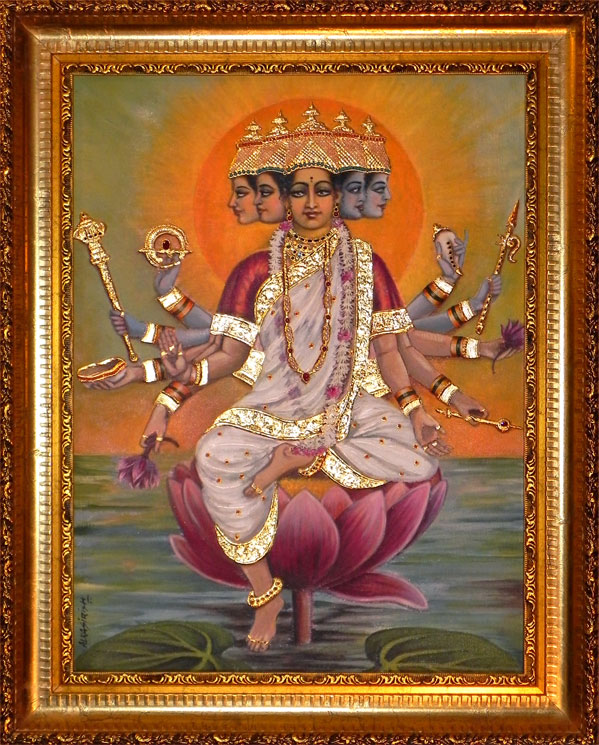
Here is where the Gita comes in with its consoling answer. Our liberation is in our own hands. What shapes our future is our intention and not the actual act. An act in itself is innocent. What gives it a colour is our intention. A surgeon may cut off a gangrenous hand in order to save the life of a patient and a robber may cut off the hand laden with gold bangles in order to steal the gold. The action is the same but the motivation is totally different so one liberates and the other binds. Hence the Gita warns us to be careful about our intentions. This is what binds us or liberates us. “Mana eva manushyanam kaaranam banda mokshayoho” In the human being the mind alone is the cause of both bondage and liberation. The Gita also gives us the yoga known as karma yoga or the yoga of action which gives very clear cut instructions how to avoid the effects of the law of karma. The only way is to hand over the results to God himself who is indeed the karma phala dhata or the giver of the fruits of karma. He knows what is best for us so if we give it over to him we will be safe. Hinduism gives us many paths of approach to God. These are known as yogas and they cater to different types of personalities. It does not insist that there is only one path and one way to approach Him. There are many paths and many ways and what we choose is decided by our temperament. Hinduism is accused of being pluralistic but pluralism means freedom - freedom of choice. It has no overall authority which dictates what every Hindu should or should not do. The first charter of human rights and liberties was give by Hinduism to every human being and hence it is imperative that we educate our children in all these facts so that they realize how fortunate they are to be born in the arms of such a loving and tolerant mother. The rishis have catered to every type of person. No one is cast out of the loving arms of the divine mother. They have given us mantras which are sound capsules which will take us to the Divine even if we do not know the meaning. They have given us yantras which are esoteric figures which we can keep in the house and gain a lot of benefit. Even those who do not understand much of its esoteric philosophy can use these mantras and yantras and attain a high state of spirituality. It is also highly tolerant of all other religions. Everyone is given freedom to worship god in his or her own way as suited to his or her own personality. No one is cast out. We can take as many lives as we want but eventually every soul will be liberated. This is the beautifully consoling clarion call of Hinduism. Krishna tells Arjuna in the Gita, “Kaunteya pratijanihi, na me bhakta pranasyati.” “O Arjuna I give you my solemn promise that my bhakta can never perish.” The Science Called Hinduism $16.95 $5.95 International Shipping Hardcover 2013 281Pages 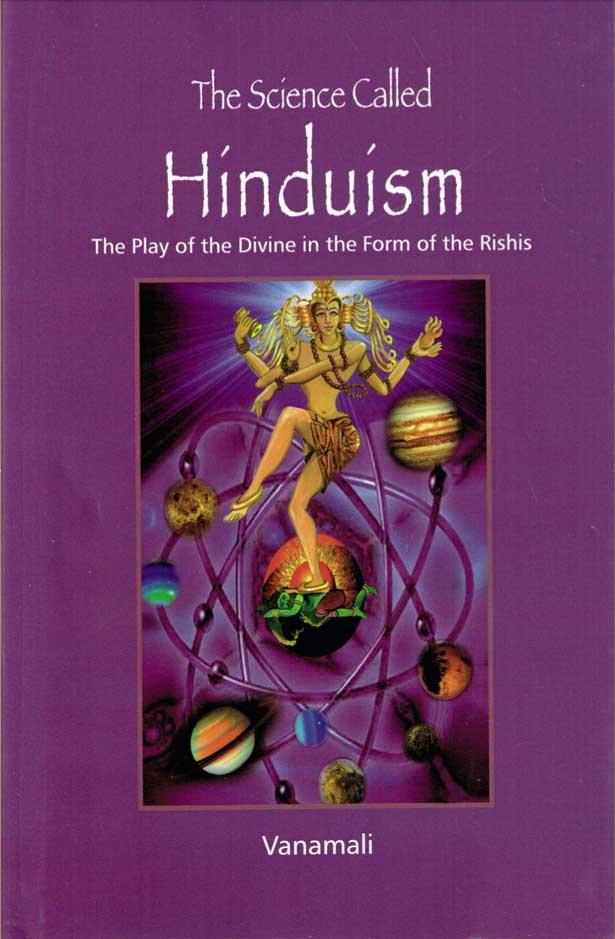 Home Vanamali Ashram Book Store |