  |
||||||
 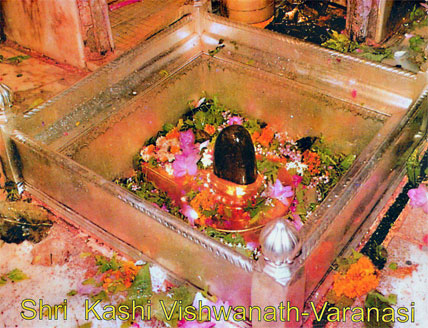 “Saurashtre Somanatham cha, Sri Saile Mallikarjuna. Ujjanyinyam Mahakalam, Omkare Malamleshwara. Himalaye to Kedaram, Dakinyam Bhimashankara. Varanasyam cha Vishweshwam, Tryambakam Gautameethate. Paralyam Vaidyanatham cha, Nagesham Darukavane. Sethu bande Ramesham, Grishnesam cha Shivalaya”. This is the famous sloka given in the Shiva Purana describing the 12 jyotirlingas of Shiva. In Hinduism, the Absolute is known as the Brahman and is formless and without attributes. But the human being has form and attributes so we need some form of the Absolute on which we can concentrate. The lingam which is a rounded, upright stone is used as a symbol of Shiva. Worship of the lingam is one of the most important aspects of the worship of Shiva. The word ”lingam” actually means a sign or characteristic. So the Shiva lingam is a sign of Shiva and helps us to remember him in his formless aspect. The Shiva lingam is also considered to be the divine phallus, containing within it the seed of the universe. From it all life is created. Together with the yoni or seat on which it rests and which corresponds to the female vulva, the yoni-lingam represents the union of man and woman, Shiva and Shakti, the cosmic Spirit in union with the cosmic Prakriti, which brings everything into existence. There are thousands of lingams all over India but some of them have a special importance. The most important of these are called jyotirlingas and they are twelve in number. As given in the sloka, their names are Somnatha, Mallikarjuna, Mahakala, Omkara, Kedara, Bhimshankara. Vishvanatha, Tryambaka, Vaidynatha, Nagesha, Rameswara and Ghushnesha. Most of these are supposed to be self formed or sprouted out of their own will. A few have been installed by human hands. Every Shiva worshipper dreams of doing a pilgrimage to all these twelve jyotirlingas at least once in his lifetime. We will now take a tour of all of them in turn. Somnatha is the name of Shiva in the town of the same name situated in Prabhas Patan in Saurashtra in the state if Gujarat in India. Prabhas Patan is the place where the Yadava clan fought amongst themselves and came to an end as per Lord Krishna’s wish. 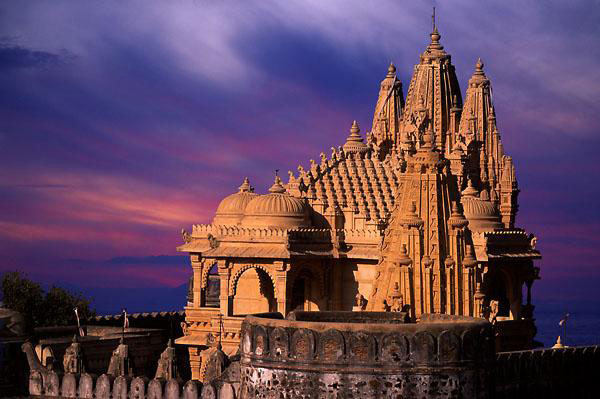 Somnatha Temple Somnatha is connected with the story of Daksha’s curse to Chandra or Soma who is the moon god in Hindu mythology. Daksha was one of the patriarchs and Soma was his son-in-law. However Daksha took a dislike of Soma and cursed him that he would wane away to nothing. Soma appealed to Lord Shiva to save him from this curse. Somnatha is the place where Soma prayed to Shiva. Shiva decreed that he would not wane away to nothing but would have only fourteen days of waning after which he would start waxing for the rest of the month. Excellent Somnatha Link! 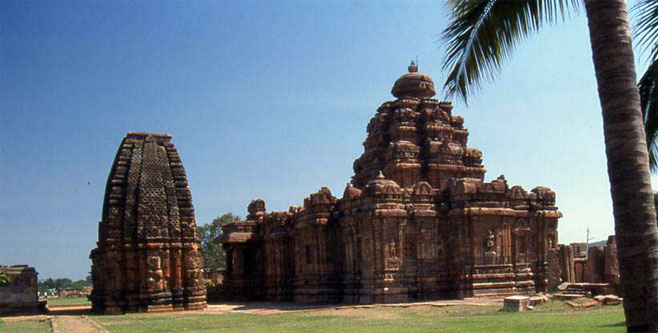 Mallikarjuna Mallikarjuna is the name of Shiva in the town of Sri Sailam near the town of Kurnool in the state of Andhra Pradesh in South India. The temple is rich in carvings and architectural wealth. Adi Shankara is supposed to have composed his great poem called “Shivananda Lahari” at this temple. The legend concerning this temple is connected with Karthikeya, the son of Shiva. He had left Kailasa and gone to stay on a hill in south India. Parvati was bereft at the departure of her son and begged Shiva to take her there. Kartikeya refused to let them live on his own hill so Shiva and Parvati took up their residence on the hill at Sri Saila from which spot they could pay periodic visits to their beloved son. An interesting thing here is the sound of buzzing which seems to come from within the granite wall at the back of the temple. Bees are supposed to have made their home here but they have never harmed any of the devotees. Excellent Mallikarjuna in Srisailam Link! 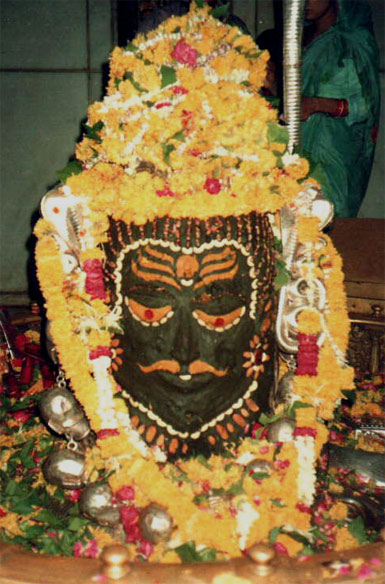 Mahakala Mahakaleshwar is situated in Madhya Pradesh in the ancient and historic town of Ujjain or Avanti. It is situated on the river Kshipra which is one of the four places in which the Kumbha Mela takes place. It is mentioned in the Bhagavad Purana as being the place where the famous rishi called Sandeepany had his gurukulam or institute of learning where all the princes of the land went for their education. In fact Lord Krishna and his brother Balarama also did their course of studies in this institution. The temple here is situated beside the cremation grounds and it is said that the ashes of this cremation ground is taken for puja in the temple. Shiva is the Lord of destruction and ashes from the burning ghat signify the ephemeral quality of life. The legend goes that four Brahmin brother were great devotees of Lord Shiva and used to worship him daily at that spot. However a demon wanted to put an end to their worship and went to kill them. The brothers were confident that their Lord would protect them and continued their worship undaunted. Suddenly the lingam burst open with a tremendous sound and Shiva leapt out brandishing the weapons of destruction. His form was that of Mahakala or the great destroyer in the form of Time. The demon was burnt to ashes. The brothers begged Shiva to stay there forever and so he did. Excellent Mahakaleshwar Jyotirlinga Link 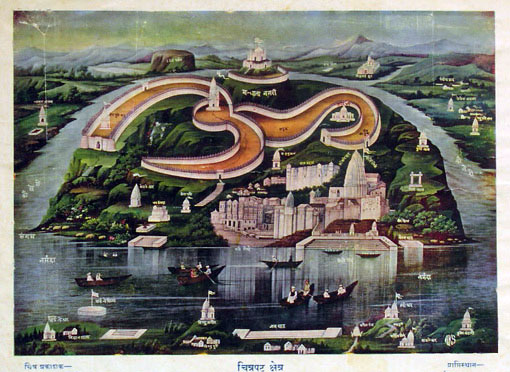 Omkareshwara is situated on an island in the middle of the river Narmada in Madhya Pradesh. The Shiva is here is also known as Mamaleshwara. Once the celestial sage Narada had gone on a visit to the mountain known as Vindhya. The sage knew that the mountain was puffed up with pride so in his usual bantering fashion he told Vindhya that the mountain Sumeru was superior to it. Vindhya decided to become the equal of Sumeru and started doing tapasya to Lord Shiva. When Shiva revealed himself, Vindhya begged him to remain there all the time so that it would be the equal of Sumeru. Omkareshwara is the place where Vindhya did tapasya. Excellent Omkareshwara Link! 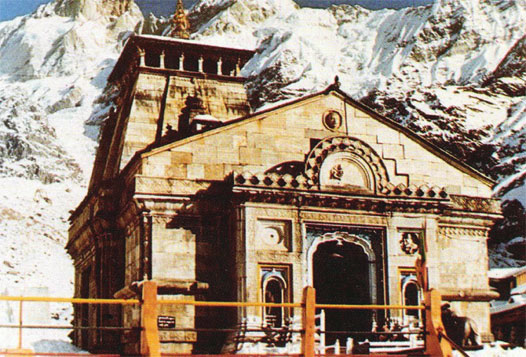 Kedarnatha Kedarnatha is the northernmost of the jyotirlingas and nestles in the snow clad Himalayas. It is snow bound for six months of the year and opens only from May to October. The last twelve kilometers of the journey to Kedarnatha has to be made on foot or pony. During the last part of their sojourn on earth the five Pandavas (heroes of the Mahabharata war) and their wife, Draupadi proceeded to the place in the Himalayas known as Kedarkanda. They went in search of their favourite deity, Shiva. They thought they saw him and gave chase but they were unable to catch him. Very soon they were joined by a wild looking dog and a noble buffalo. They came to realize that the buffalo was none other than their favourite deity. Once again they tried to catch it but it ran away. The Pandavas chased the buffalo and at last each of the brothers managed to catch one part of the animal. To their consternation it came apart into five pieces in their hands. They threw the pieces far and wide. Those spots where the pieces fell came to be known as the panch Kedars or the five Kedars and are important pilgrim spots in the Himalayas. The hump of the buffalo fell at a most auspicious spot and came to be known as Kedarnatha. The lingam at Kedarnatha is in the shape of the hump of a buffalo. Excellent Kedarnatha Link! 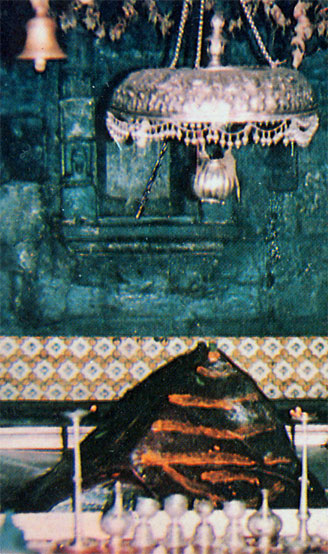 Kedarnatha Lingam Bhimshankara is situated in the Sahyadri hills of Maharashtra. The easiest way to go there is via Pune. This is the spot where Shiva is said to have destroyed the three demons known as Tripurasuras. The legend connected with this place has to do with one of the brothers of the demon known as Kumbhakarna who was a brother of Ravana, the demon king oof Lanka. His son was called Bhima. When he heard of the death of his father at the hands of Rama, he swore vengeance on all the devotees of Vishnu (Rama was an incarnation of Vishnu). His first target was the king called Kamarupa whom he captured and threw into a dungeon along with his wife. The couple started earnest prayers to Shiva to save them. When he heard this, Bhima rushed to the dungeon with upraised sword to kill him. At that moment Shiva split open the lingam and jumped out of it and killed the demon. The couple begged him to remain there and hence the lingam here is known as Bhimshankara. 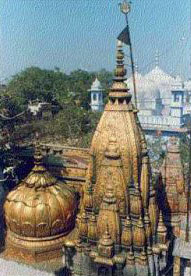 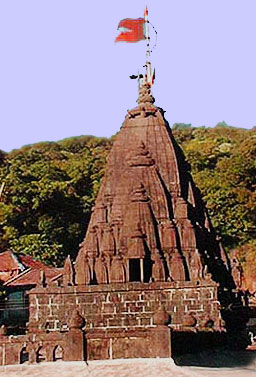 Vishvanatha temple Bhimashankar Temple Vishvanatha temple is situated on the banks of the holy river Ganga in Varanasi in the state of Uttar Pradesh. It is the most famous temple of Shiva in India and attracts thousands of pilgrims every year. The famous Manikaran ghat is the place where countless Hindus have been cremated. The fires of cremation have never been extinguished here since time immemorial since dead bodies are being constantly brought there. Anyone who sits for a few minutes at this ghat will realize the transitory quality of life and start looking deeper into the meaning of life. The creator Brahma himself is supposed to have done tapasya in this spot. It is said that Varanasi will not be destroyed even at the time of the great deluge when the rest of the world goes into dissolution. Shiva will raise the city on the point of his trident and protect it while destruction rages all around. There is another story connected with this city. Once Shiva and Parvati had gone to the world of Brahma. He began reciting hymns through all his five mouths in praise of Shiva. But one of the mouths was making mistakes and so Shiva, who was a perfectionist where music was concerned, plucked off the head which was making mistakes. But since this was a great crime, Shiva found that he could not shake off the head which had stuck to his back. For many years he went round with the head on his back. It was only when he went to the holy city of Varanasi that the head fell off. So Shiva decided that he would stay there in the form of a lingam. This lingam is called Vishwanatha or the Lord of the universe. The first humans to worship there were Swaymbhu Manu and his wife Shatarupa who were the first couple to be created by Brahma. 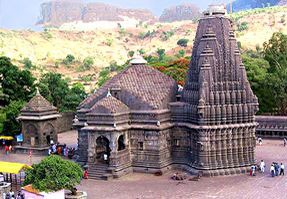 Tryambakeshwara Tryambakeshwara is situated on the banks of the Godavari River. In fact the river has its origin on a hill above the temple. The temple is about ninety kilometers from the pilgrim city of Nasik in the state of Maharashtra. The place is associated with the sage Gautama and his wife Ahalya. They had prayed to Shiva for a long time. At last the Lord appeared and asked them to choose a boon. He begged Shiva to allow the Ganga to flow beside his hermitage so that he could bathe in her purifying waters and expiate for his sin in having killed a cow by accident. Shiva granted the boon. However Ganga insisted that she would go there only if Shiva took up his residence there. This was agreed upon and Shiva stayed there in the form of a lingam. Ganga flowed beside him and took the name Godavari. To reach the source of the Godavari one has to climb some hazardous steps up the mountain near the temple. The steps lead you to a small shrine where water gushes out of a stone cow’s mouth. One can also trek up the mountain to the top where the river actually has her source. 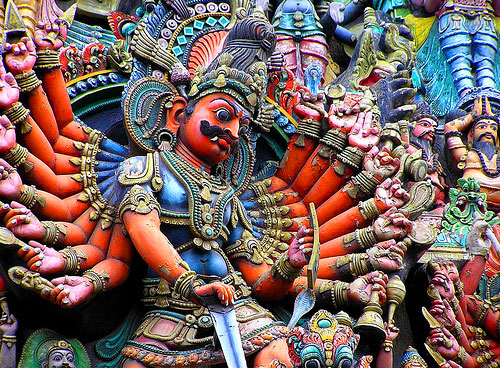 The temple of Vaidyanatha is situated in the state of Bihar in the town of Deogarh. Ravana, the demon king of Lanka, was a great devotee of Shiva. He practiced intense tapasya in the Himalayas, but still Shiva failed to appear, So he made a fire and decided to sacrifice all his ten heads. He started throwing them one by one into the fire. After the ninth, Shiva appeared and asked him what he wanted. Ravana prayed for superhuman strength and the restoration of his nine heads. Only Shiva could grant such a boon for he was Vaidyanatha, the Lord of all physicians. Shiva also gave him a wonderful jyotirlinga and told him to take it straight to his capital city of Lanka. He warned him never to put it down. Ravana started back carrying the radiant lingam. The gods feared that if he took it to Lanka, he would indeed become invincible so they sent Ganesha to thwart him. Ganesha took the form of a young brahmachari and appeared before Ravana just as he felt a terrible urge to answer the call of nature. Ravana was forced to give the lingam to the boy who had so providentially appeared before him and warned him never to keep it down. Hardly had Ravana gone than Ganesha put the lingam down. When Ravana returned he found no trace of the boy and try as he would he was unable to budge the lingam which had become rooted to the spot! This is the lingam which is known as Vaidyanatha. Excellent Vaidyanatha Link! 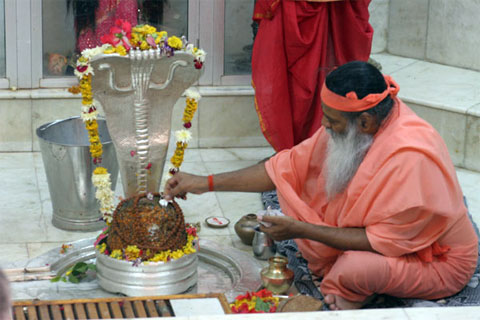 His Holiness Sri Sri Ganapathi Sachchidananda Swamiji of Mysore worshiping Nagesha Linga The tenth jyotirlinga is known as Nagesha and is situated near the pilgrim city of Dwaraka in Gujarat. There was once a merchant who was a great devotee of Lord Shiva. During his travels he often had to cross a forest which was inhabited by a demoness called Daruka who kept harassing him. He begged Shiva to help him. Shiva came with his snakes or “nagas” and drove Daruka away. Daruka worshipped Parvati who gave her another forest to roam about without troubling anybody. The lingam which was worshipped by the merchant came to be known as Nageshwara, Lord of serpents. Parvati also took up residence here and is known as Nageshwari. NAGESWARA MAHADEVA TEMPLE The
Nageswara Mahadeva temple is considered to be one of the twelve
important jyotirlingams. Jyotirlingam actually means a column of light
in the shape of a linga. The first jyotirlingam was an immeasurable
column of light made by Lord Shiva in order to prove his superiority
over the tri-murtis (Brahma, Vishnu and Mahadeva). Brahma and Vishnu
were astonished to see this light. A voice emanated from the column
asking each of them to find out the depth and height of the column of
light. Vishnu opted to go down while Brahma chose to go up. Vishnu in
the form of Varaha (the cosmic boar) went down for eons and could not
discover the source of the light. He came up and declared his inability
to do so. Brahma aslo went up for eons and also failed to discover the
beginning of the light. As he was coming down disappointed, he saw a
keora flower which was falling down from Shiva’s locks. He begged her
to swear that she had seen him at the top. She agreed reluctantly.
Brahma swore to Shiva that he had seen the top of the column of light
and the keora flower nodded her head. Shiva was furious and cursed
Brahma that he would never have any temples in his name and no one
would worship him. He told the keora flower that henceforth she would
never be used in his puja. She begged for forgiveness and he relented
and said that she could be used outside the temple for decoration.
Shiva also declared that Vishnu would be worshipped for all eternity
and have many temples in his name.
Aum Namashivaaya.
The jyotirlingas commemerate this event and they denote the supreme indivisible reality from which Shiva appears. The first appearance is supposed to have happened in Thiruvannamali in Tamil Nadu and is still celebrated by lighting a huge bonfire on top of the hill every pournamai in the month of Kartika (November). There are actually sixty-four jyotirlingas out of which twelve are considered to be specially auspicious. Each of these jyotiringas takes the name of the presiding deity and each is considered to be a separate manifestaton of Shiva. The twelve jyotirlingas are Somnath is Gujarat, Mallikarjuna in Srisailam, Andhra Pradesh, Mahakaleswara at Ujjain in Madhya Pradesh, Omkareswara in Madhya Pradesh, Kedarnath in the Himalayas, Bhimshankara in Maharashtra, Kasi Viswanatha at Varanasi in Uttar Pradesh, Triambakeshwar in Maharashtra, Vaidyanatha at Deogarh in Jharkhand, Nageswara in Dwaraka, Rameshwara at Rameswaram in Tamil Nadu, and Grishneshwara in Aurangabad in Maharashtra. 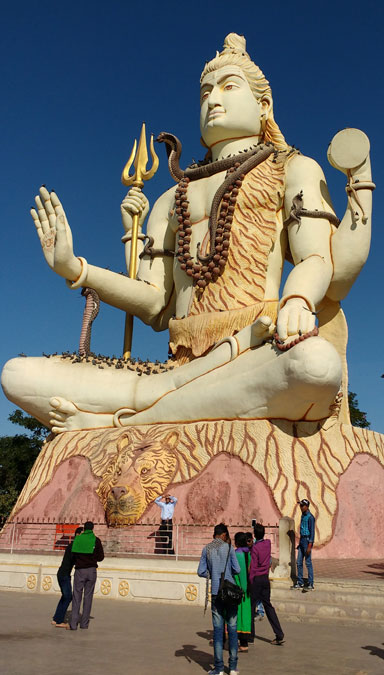 The Shiva Purana says that the Nageshvara Jyotirlinga is in 'Darukavana', which is forest mentioned in many puranas. The Pandavas are supposed to have spent some time there during their twelve years of exile. Once there was a demon called Daruka who had a wife called Daaruki who worshipped Parvati. Seeing her great devotion Parvati gave her a boon that the forest in which she performed her tapas would be called Darukavana in her honour and wherever she went the forest would follow her. In order to save the demons from punishment from the gods she removed the forest into the sea from where they started to harass the hermits and other devotees of Shiva whom they caught and confined in their under water lair. Her husband, Daruka once attacked a Shiva devotee called Supriya and imprisoned him along with many others in his city of Darukavana, under the sea inhabited by sea snakes and demons. Supriya made a lingam and urged all the prisoners to chant the five lettered mantra of Shiva, „AumNamashivaaya“. Shiva appeared and gave him a divine weapon that saved his life. The demons were killed. The lingam was given the name of Nageshwara. Parvati was known as Nageswari. This is the 10th of the jyotirlingas. It has the power to take away the effects of all types of poisonous bites by snakes and insects. All Shiva temples have the gomukham, or the channel through which the water is poured over the deity, facing north. Here it is facing east. It is said that once a devotee called Namadev was singing bhajans in front of the Lord. Some other devotees asked him to stand to a side so that he would not hide the lingam. Namadev promptly asked them to show him one direction in which the Lord does not exist. This angered them and they promptly carried him and dumped him on the south side. To their surprise they found that the lingam now turned to the south so that the gomukham faced east. This temple is located on the road leading from Dwaraka proper to the island of Bet Dwaraka. I went there on my return from Bet Dwaraka. The compound is dominated by a huge statue of Shiva. I knew that the lingam was inside a cave but it was all built up so that the cave was covered by a huge modern structure. From the door to the cave people were selling puja things at exorbitant rates without which you were not allowed to enter the cave. Even after buying you were held up just before entering the cave by priests who demanded more money for various purposes. This was the only temple in Gujarat to which I had so far gone that this has happened so I was really sad. However having come all this way I was determined to get in even if I had to pay. Once inside I was overpowered by the peace and purity of the place.The lingam was of sandstone I think and was possibly being eroded so they had covered it with glass. There was a hole on top through which we could do abhishekam and offer flowers etc. Only about ten people would be let in at a time since there was no place inside the cave. Unfortunately the priest kept shouting at some of those who had entered with me for some offence or other. Anyway I finished my own puja and got out before he started shouting at me. I had come here after Bet Dwaraka so it was a marked contrast. Anyway it was all a lesson in acceptance I suppose and I accepted it as such. 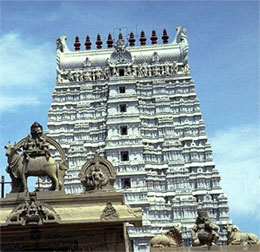 Ramanatha Swamy Temple Rameshwaram The huge temple of Rameshwaram is situated on the island called Rameshwaran in the state of Tamilnadu. This spot is the closest bit of land in India to the island of Sri Lanka. Ravana, the demon king of Lanka had abducted Sita, the wife of Rama, king of Ayodhya and taken her to his island fortress. Rama came to rescue her but before he could cross the straits which separated the mainland from the island of Lanka, he made a lingam of Shiva and prayed to him to help him rescue his wife. Shiva appeared and blessed him with all success. Rama requested Shiva to stay in that spot forever. This is the lingam called Ramalingeswara and it is one of the most famous places of worship in India. 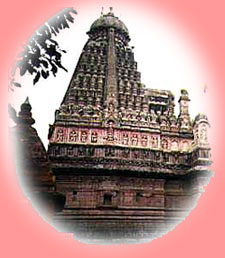 Grishneswara
 is the twelfth and last of the jyotirlingas. It is
situated close to the famous caves of Ellora. Once there was a Brahmin
called Sudharma who had a wife called Sudeha. They had no children and
so his wife asked him to marry her niece, Ghrishna in order to get a
son. She was a great devotee of Lord Shiva and she made a vow that she
would make one hundred and one lingams of Shiva daily and worship them.
At the end of her puja she would immerse the lingams in the pond near
by. After having completed one lakh of pujas she conceived and got a
lovely baby boy. As can be expected her aunt’s nature changed with the
birth of the child and one day she killed the baby and threw the body
into the pond in which the lingams were immersed. Next morning Ghrishna
got up and started her daily ritual of worshipping Shiva. She refused
to be distracted even when her husband announced the disappearance of
the baby. At the end of her puja, Shiva who was pleased with her
devotion restored the baby to her. When he raised his trident to kill
her aunt, Ghrishna begged him to spare her life and asked for the boon
that he would stay near the pond in the form of a lingam. He agreed and
this lingam is known as
Grishneswara
The lingam is a formless figure representing the beginingless and endless nature of Shiva, the Absolute. A jyotir-lingam is a shrine where Lord Shiva is worshipped in the form of a jyoti or radiance. Traditionally there are twelve jyotirlingams in India. Out of these six of them are to be found in Maharashtra. Fortunate indeed are the people who are lucky enough to visit all twelve at some point of time in their lives. The origin of these jyotirlingams is to be found in a story in the Shiva Mahapurana. The Trinity in Hinduism is known as Brahma, the creator, Vishnu, the preserver and Shiva, the destroyer. Once it is said that Brahma and Vishnu had an argument as to which of the three was superior. In the midst of this argument, Shiva took the form of a huge pillar of light or jyotirlingam and asked Brahma and Vishnu to find out the beginning and end of this pillar of light. Brahma went upwards for thousands of years but failed to find the source. Vishnu went down and returned without discovering the end of this pillar. Shiva asked Brahma if he had seen the top and he untruthfully said that he had. He asked Vishnu if he had reached the bottom and Vishnu said he could not find out where the light ended. Shiva cursed Brahma that nobody would worship him and that no temples would ever be built for him! The place where this first jyotirlingam manifested was on the holy hill known as Annamalai around which grew the city called Tiruvannamali in Tamil Nadu. This is the first of the jyotirlingas and Shiva is known as Arunachala at this place. Originally there were supposed to be 64 jyotirlingas in India but out of these 12 are considered to be most important. These twelve jyotirlingas are Somnatha in Gujarat, Mallikarjuna at Srisailam in Andhra Pradesh, Mahakaleswar in Ujjain in Madhya Pradesh, Omkareshwara in Madhya Pradesh, Kedarnatha in Uttarakhand, Bhimashankara in Pune, Maharashtra, Vishwanatha in Varanasi in Uttar Pradesh, Tryambakeshwara at Nasik in Maharashtra, Vaidyantha in Deoghar in Jharkhand, Nagesha near Dwaraka in Maharashtra, Rameshwara at Rameshwaram in Tamil Nadu and Grishneshwara near Ellora in Maharashtra. It is said that those who are in a higher state of consciousness can see the column of light emanating from these jyotirlingas, connecting them to the Shiva consciousness. About 30 km to the west of Aurangabad is the village of Verul in which is situated the famous Ellora caves. The 12th jyotirlinga called Grishneshwar is also found in this village. This is the last of the jyotirlingas and a visit to this is compulsory for those who wish to make a round of all the 12. Originally this was a settlement of the Naga tribe. The village of Verul is situated on the banks of the river called Yelaganga. The legend goes that once the king called Yela went hunting. He killed some animals which belonged to the sages who were living in the forest. The sages cursed him that his body would become infested with insects. He wandered all alone in the forest, in great distress. Once his throat was parched with thirst. He found a small bit of water made by the hooves of a horse. As soon as the king drank the water, the insects left his body. The king did severe tapas at that place. Lord Brahma appeared and created a lake nearby. This is the place which later came to be known as Shivalaya. The river Yelagana flows near it. According to the Shiva Purana, a Brahmin called Sudharma lived at this place along with his wife Sudeha. The couple was childless. Both of them undertook many types of rituals in order to get a child but all in vain. At last Sudeha begged her husband to take her sister, Ghushma as a second wife. She told Ghushma to worship Shiva with 101 lingas every day and immerse them into the lake at the end of her worship. With the blessings of Lord Shiva, Ghushma conceived and gave birth to a baby boy. Even though she was the one who encouraged her husband to marry her sister, Sudeha became bitterly jealous of her own sister and one night she killed the baby and threw him into the lake into which Ghushma used to immerse her 101 lingas. In the morning the couple were devastated when they discovered that their son was missing. Undeterred even by this unbearable sorrow Ghushma continued her usual worship of 101 lingas. At the end of her worship Shiva restored her son. He appeared before her and told her to ask for a boon. She begged him to remain at that spot in the form of a jyotirlinga for the benefit of humanity and to take on her name. This is the famous jyotirlingam called Grishneshwara. The word Grishneshwara also means “the Lord of compassion.” The temple is an exquisite work of art. Of course it was also devastated during the Moghul rule but was renovated by the famous queen Ahalyabai Holkar of Indore in the 18th century. There is a beautiful hall in front of the linga with a huge figure of Nandi. The ten incarnations of Vishnu are carved around the temple. One has to go down a few steps from the hall to reach the sanctum which is on a lower level. The lingam is quite small. 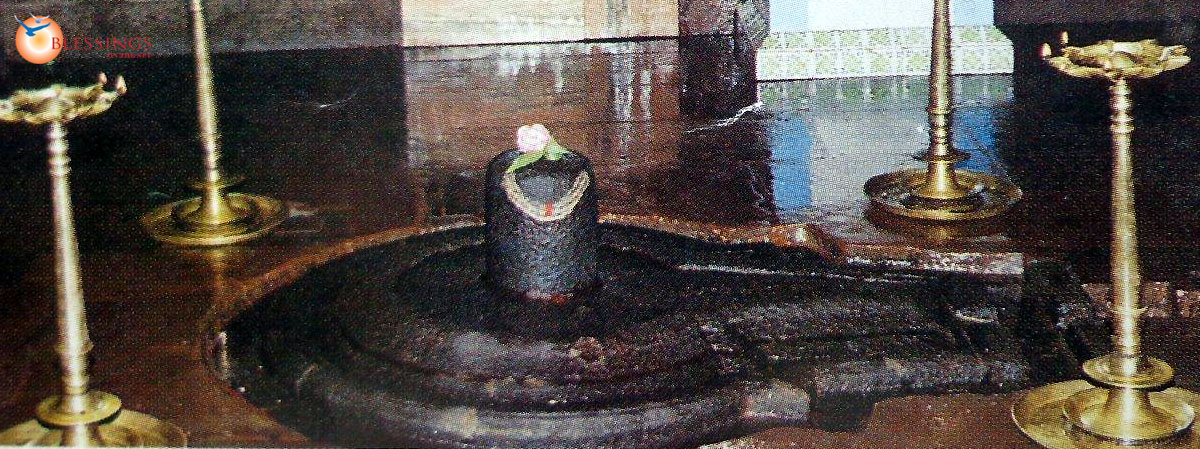 My visit to Ellora was actually prompted by my desire to visit Grishneshwara which is the 12th jyotirlingam to which I had not gone. Needless to say I ran to the temple as soon as we reached Ellora. It was sunset time, the time for arati and the temple was crowded. I must admit I was a bit disappointed. However I was prompted to go again in the morning and had a wonderful darshana. There was no one around and I could go in and pour water over the lingam in the ritual called abhishekam and offer flowers and bel leaves to him. The priest hardly noticed me as I sat in a corner of the sanctum blissfully filled with the compassion of the Lord. Aum Namashivaaya! Devotees of Shiva consider it to be a rare good fortune to be able to make a visit to all the twelve jyotirlingas in one lifetime. Aum Namashivaya 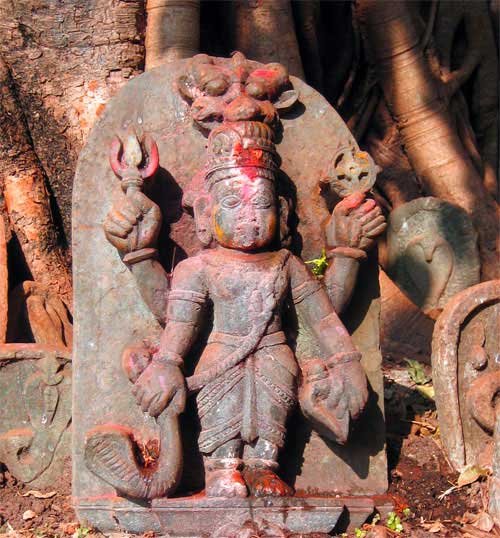 |
||||||
|